

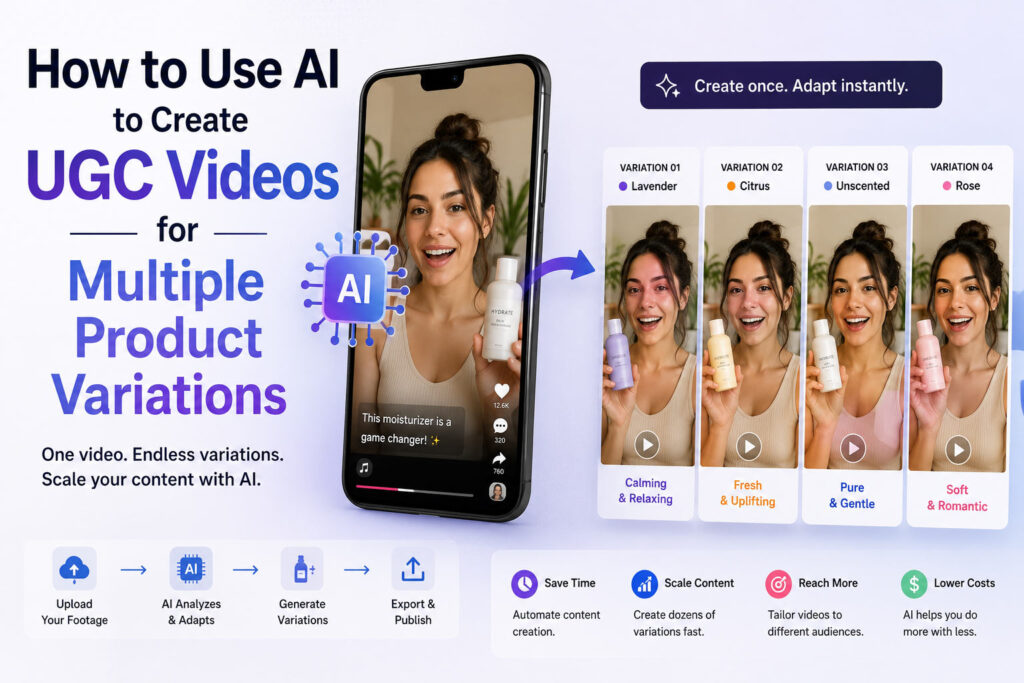
Ten colors, five sizes, a dozen flavors — one brief. Here's how to turn a single product line into a full set of on-brand UGC ads without a reshoot for every SKU.
If your product comes in more than one version, you already know the problem: a single UGC ad can't carry the whole catalog. A video that only shows the black colorway doesn't sell the tan one. A script written for your 8oz size doesn't fit your travel-size SKU. Traditionally, that meant reshooting for every variant — or picking one hero product and hoping the rest ride along. AI changes that math entirely.
Why product variations break traditional UGC production
Every variant a creator has to film adds cost and coordination on top of the base shoot: a new prop, a new angle, sometimes a new location if the product looks different in different settings. Multiply that by 6 colorways or 10 SKUs and a "simple" UGC shoot turns into a full production calendar. Most brands respond by cutting corners — filming one variant and hoping the ad performs across the whole catalog, which usually costs conversions on every SKU except the one on screen.
This is the exact bottleneck AI-generated UGC was built to remove. Instead of one video standing in for ten products, you can generate a version of the same ad for every variant, each one showing the actual color, size, or flavor a shopper is about to click on.
The workflow: one brief, every variant
Lock the script and hook once
Write (or have written) a single script structure — hook, benefit, CTA — that works across the whole product line. This is the piece that stays constant.
Swap the product reference per variant
Feed each product image or SKU into the same script. Modern AI UGC tools composite the actual product into the AI actor's hands, so the color or size on screen matches what's actually for sale.
Batch-generate the set
Render all variants in one pass rather than one at a time. This is where AI UGC pulls furthest ahead of traditional production — a batch of 10-20 variant videos can render in the time a single creator shoot takes to schedule.
Adjust the hook per top performer
Once you see which variant or angle is converting, generate 2-3 hook variations for that specific SKU instead of spreading budget evenly across all of them.
Platforms built for this workflow now handle the heavy lifting automatically — pulling product data straight from a URL or catalog feed and rendering variant sets without manual re-briefing for each one, a pattern Influencer Marketing Hub has documented across several leading AI UGC tools.
You're not making ten ads. You're making one ad, ten times, for the ten things people are actually about to buy.
— The shift from hero-product ads to full-catalog UGCKeep the brand consistent while the product changes
The failure mode with multi-variant AI UGC isn't quality — it's drift. If every variant uses a different avatar, tone, or pacing, the set stops feeling like one campaign. Lock down a small set of constants before you generate anything:
Before you batch-generate, lock down:
- One presenter (or a small, defined rotation) across the whole variant set
- One script skeleton — hook, benefit, CTA — that only swaps the product-specific line
- One visual setting or backdrop style, so the set reads as a single campaign
- One CTA and offer structure, so performance data is comparable across variants
What to test first
Don't launch all variants at even spend. Start with your top 3-5 SKUs by sales volume, since that's where the fastest, most reliable performance signal is. As you saw in our earlier breakdown of AI UGC versus real creators, the core advantage of AI is iteration speed — use that speed on the products people are already buying before scaling out to the rest of the catalog. Testing 3-5 creative variants per campaign before scaling spend is the baseline most performance marketers now recommend, and multi-variant catalogs are simply that same rule applied per SKU.
Related: not sure whether AI UGC is the right call for your brand at all? Start with Real UGC Creators vs. AI Tools.
Related: want the pricing math for a variant set? See our full cost breakdown of AI UGC video production.
How Pearce Design approaches multi-variant campaigns
We build AI UGC video ads for DTC brands with full product lines, not just a single hero SKU — one script, one presenter, every variant rendered and delivered ready to run. You share your catalog and platforms; we handle the script, product compositing, and batch production. See how the process works on our GOHARDUS case study, or check our FAQ for turnaround and pricing questions before you reach out directly.
Got a full product line to cover?
Tell us your SKUs, platforms, and audience — we'll turn it into a full set of ready-to-run UGC ads, one brief at a time.
See How It WorksSources: Influencer Marketing Hub, "UGC Video Makers for High-Performing Social Ads in 2026" — influencermarketinghub.com. VidMuse, "AI UGC: Complete Guide to AI UGC Video Ads in 2026" — vidmuse.ai.